
From Aid Recipients to Local Producers
The Next Phase of U.S. Food Assistance
April 17, 2026
Chris Greene, CEO, Meds & Food for Kids
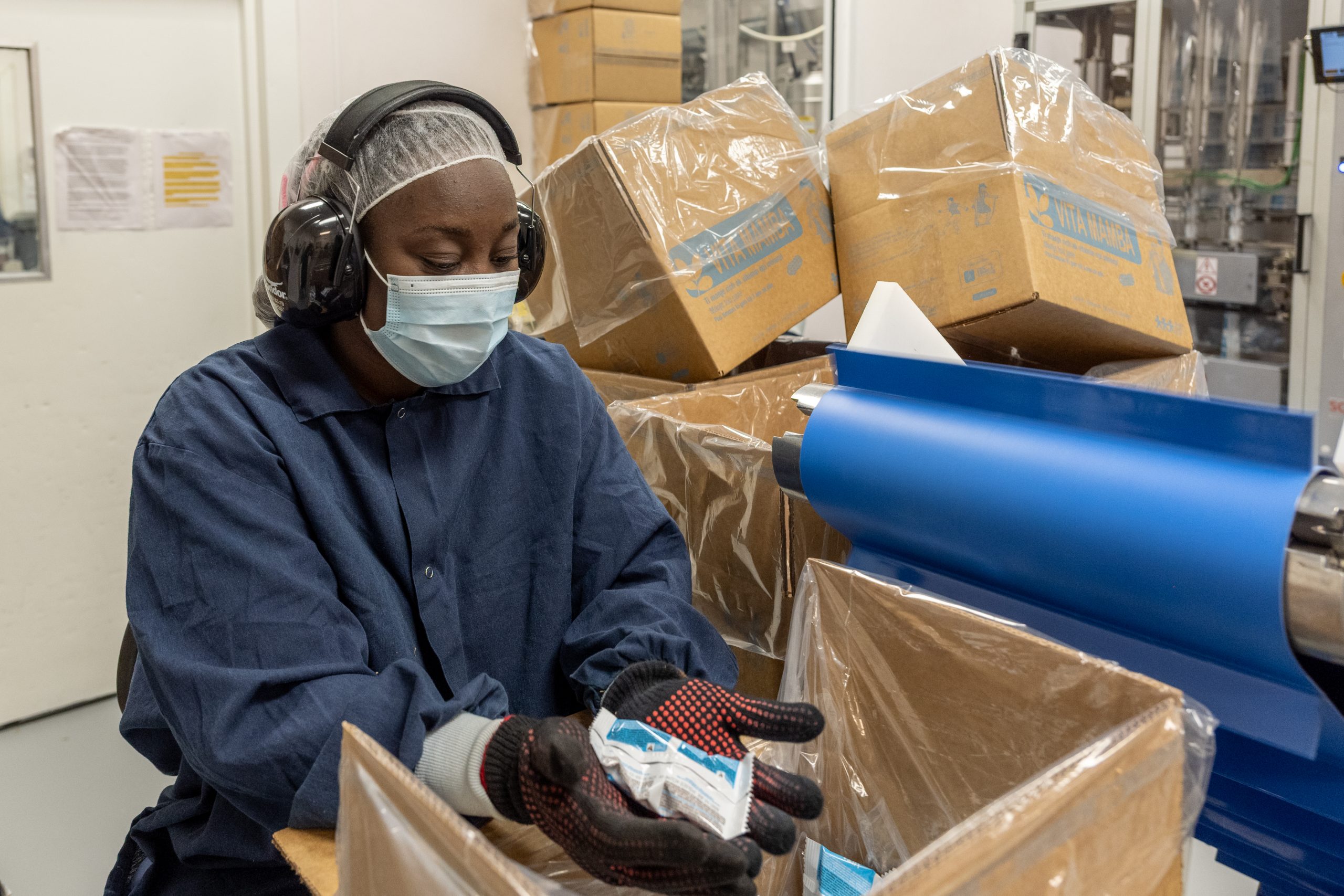
I’ve spent more than a decade building certified nutrition manufacturing in Haiti. Local production in a fragile state is slower than shipping from the U.S. It requires disciplined quality systems, workforce development, and infrastructure investment – with no immediate political reward.
But when it works, it changes the equation. Communities shift from recipients to producers. Supply chains get anchored locally. Institutional competence builds. Dependency shrinks.
That shift isn’t just humanitarian. It’s strategic.
A System Built for a Different World
The United States has responded to global hunger the same way since 1954. The Food for Peace Act solved two real problems simultaneously — hunger abroad and agricultural surplus at home — and it has endured because it built a durable political coalition: farmers, millers, mariners, ports, and aid agencies all with skin in the game.
That system has saved lives. It is also highly effective at moving food — and far less effective at reducing the need to move it. It wasn’t designed for a world where 673 million people are chronically undernourished, 60-70% of the food-insecure live in conflict-affected countries, and the average displacement now exceeds a decade.
We are no longer primarily responding to short-term crop failure. We are operating inside long-term fragility — weak institutions, broken markets, conflict economies, and climate volatility layered on top of one another.
Different Problem. Different Tool.
Acute famine requires surge logistics.
Fifteen-year fragility requires something different.
The capacity for crisis response must stay intact. When famine hits, the United States needs to move American commodities rapidly and at scale. That capability is strategic infrastructure — it should be treated like a reserve, clearly defined, funded, and deliberately maintained.
But crisis response capacity alone is not a strategy for chronic instability. And chronic instability is the dominant operating environment.
This is not an argument for dismantling what works. It is an argument for evolving it.
Modernization means preserving strong funding levels. It also means expanding procurement flexibility where the evidence supports it — pairing U.S. commodities for acute emergencies with certified, standards-driven regional and local manufacturing in protracted contexts.
Local manufacturing carries real risk: governance risk, quality risk, political risk. So does permanent dependency. We just don’t measure it the same way. Localizing production is not a retreat from American interests. It is how you protect them.
It’s also geopolitical.
Food Security is National Security
China’s Belt and Road Initiative has deployed over a trillion dollars to embed influence through infrastructure and supply chains. Food systems are part of that strategy. Countries that cannot produce, process, or control their own food supply remain strategically vulnerable.
If U.S. assistance reinforces long-term import dependency without building production capacity where feasible, we are financing consumption and calling it stability.
The downstream effects are predictable: fragile food systems generate migration pressure, migration pressure becomes domestic political pressure, and domestic political pressure reshapes foreign policy. Food security is not only humanitarian. It is national security.
From Response to Strategy
The real choice isn’t between American farmers and foreign factories. It never was.
The real choice is whether U.S. food assistance remains a permanent response pipeline — or becomes a strategy.
Protect the capacity for crisis response.
Deploy commodities for acute emergencies.
Build certified regional and local capacity in protracted contexts — to reduce the frequency of those emergencies in the first place.
The humanitarian system was designed to respond. The next phase must also build — or we will continue financing permanent responses in environments that never stabilize. That is not a rejection of what has worked. It is an adaptation to the world we are actually operating in.
The capability exists. Expanding Local and Regional Procurement policy to recognize certified local manufacturing in protracted contexts is a logical next step.